People will often refer to protesting as a “right” or as “freedom of speech”, or they will simply regard the act as a bastion of democratic freedom, the pinnacle of political expression. In regards to these perspectives, the act of protesting against the state is seen as a virtue of the state itself. That the American government so idealistically believes in the moral imperatives of “freedom” and “liberty” is, apparently, what allows us the privilege of speaking out in protest against it. I find this sentiment to be backwards and misplaced. A protest is the crystallization of opposition against the state, a culmination of anger and dissent within a populace directed at the oppressive forces of government. It is in no way something that is given or earned, but rather, it is a bubbling resentment breaking through to the surface; protesting against the government is the innate culmination of grievance from the victims of the repressive forces of the state. This organization of everyday citizens, of workers, of the proletariat, is exactly what a bourgeois state fears. They know better than anyone the power of a united populace, which is precisely why they direct their violence in manners that are inherently dividing.
The question of a “violent” vs “non-violent” protest is inherently misguided, as the definition for the violence in question varies wildly from person to person based on a combination of ignorance and interests. Many assume that a protest, or collective action of any kind really, is violent when certain criteria are met: the throwing of objects, the burning of vehicles, vandalism. In such cases, the violence must then be reciprocated by law enforcement, or risk the next broken window spelling a series of events that culminate in the complete destruction of human society! The fact remains, however, that due to people’s individual perspectives (perspectives that have been shaped by the very state interests which find themselves in question), many often selectively identify violence, all to serve a larger narrative. For instance: one might be quick to blame a protestor, the very harbingers of chaos that they are, for their fault in torching an unoccupied car, but a passive observer might easily miss the full picture. More times than not, this display is the result of a righteous anger, frustration manifest, in response to particular oppressive successes by the state.
The every-day violence, the threats placed upon working peoples for the purposes of maintaining our society’s class structure, scrapes by unnoticed. The powers at be would have you believe that it is not violent to fire a worker, even if they and their family will starve; that it is not violent to force someone into medical debt for the rest of their life, even if it was to prevent death or suffering. This is not violence, per say, but instead the nihilistic realities of life, untenable forces of nature that are as inevitable as death itself. Beyond being a horribly convenient truth for those who control the leavers of governmental power, this explanation also serves to obfuscate the truth behind any so-called “violent protest”: they are responses to an attack on one’s self determination. These are forces compelled to burst free from the soul, held back and pummeled into submission; they are an expression of anger and frustration finally bubbling to the surface, given the appropriate conditions.
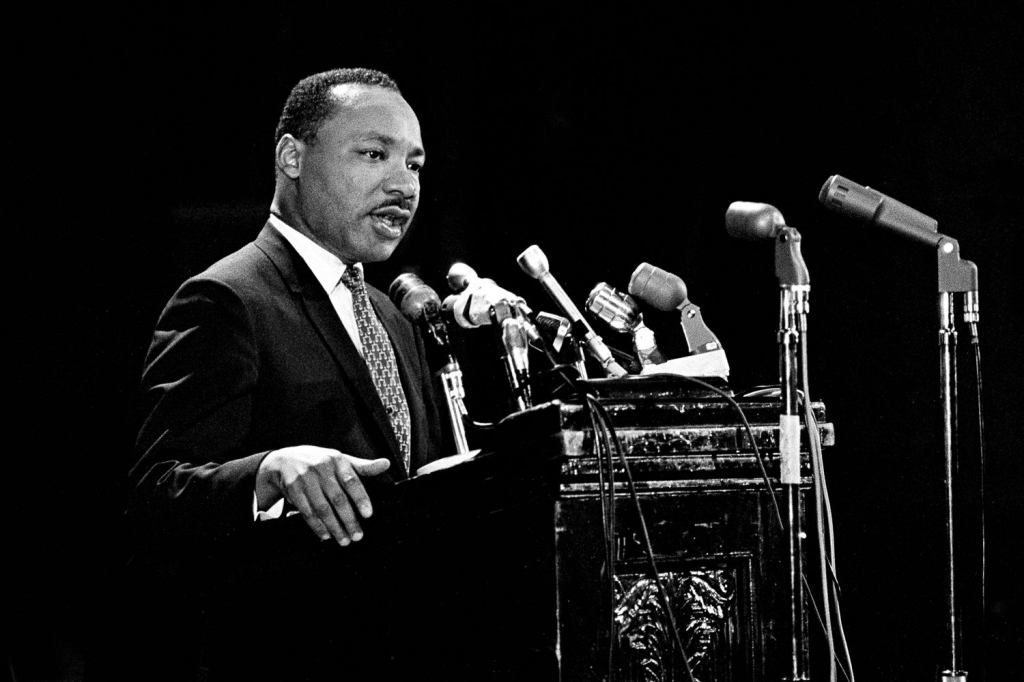
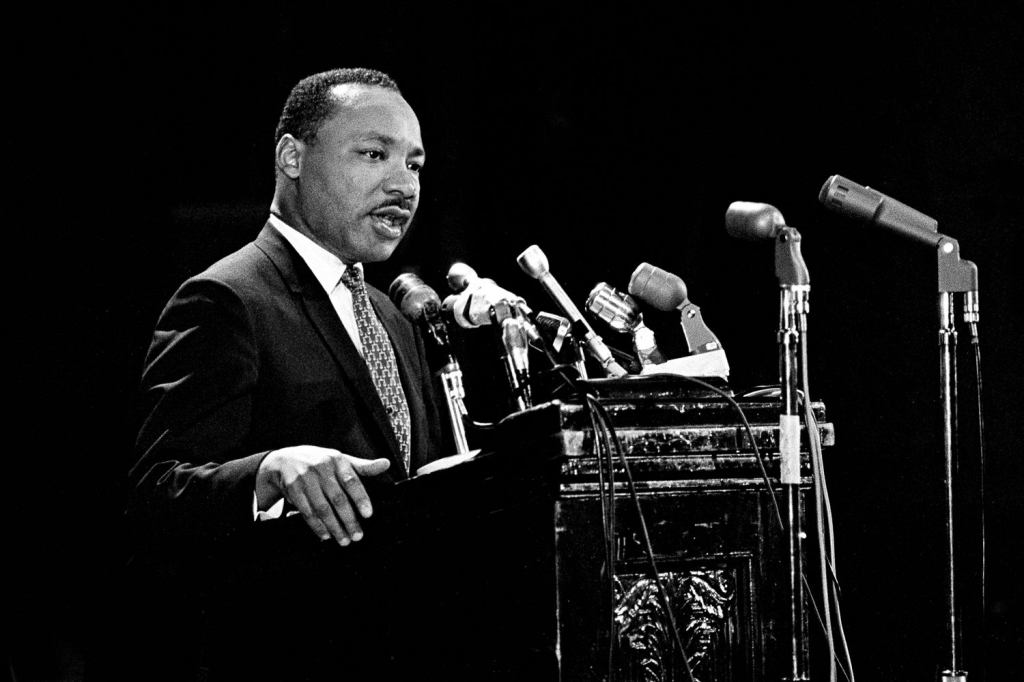
Rev. Dr. Martin Luther King delivering a speech at Stanford University in 1967
I want to briefly turn to words spoken by the late Rev. Dr. Martin Luther King Jr. in a statement to Stanford University in 1967:
“….riots do not develop out of thin air. Certain conditions continue to exist in our society, which must be condemned as vigorously as we condemn riots. And in the final analysis, a riot is the language of the unheard; what is it that America has failed to hear? It has failed to hear that the plight of the negro poor has worsend over the last few years, it has failed to hear that the promises of freedom and justice have not been met, and it has failed to hear that large segments of white society are more concerned with tranquility and the status-quo than about justice, equality, and humanity. And in a real sense, our nations summers of riots are caused by our nations winters of delay. And as long as America postpones justice, we stand in the position of having these recurrences of violence and riots over and over again. Social justice and progress are the absolute guarantors of riot prevention.”
Dr. Martin Luther King statement to Stanford 1967
Dr. King’s last sentence in this quote represents to me the most clear and concise through-line of rhetoric regarding “violent protests”: the violence of a protest is directly in response to the violence of the state. The violence of an unjust, unequal society, is met with the frustration and anger that it deserves, and yet we are made to believe any such riot simply exists to destroy all that is good and right? Is it violent to refuse to be silenced in the face of oppression? Is it violent to refuse to have your life, your very body, taken from you? The ruling class sees it as violence, and they respond with violence of their own. To them, any amount of opposition to the status quo is a threat to themselves and therefore “violent”. This shows that, if anything, violence is nothing more than a tool, the manifestation of power, of agency, of will itself. It is used with abandon by the ruling capitalist class, the bourgeoisie, to maintain their hegemonic control over the production of resources and it’s beneficiaries. The apparatus of the state is the conduit for this control, and violence is the tool which enacts it.
The only viable means of confronting the oppressive will of the bourgeois state and its scion of violence is by courting our own champion of the same make. If violence is a tool, the projection of will, than those who find themselves under its ire can only hope to defend themselves with a similar force of equal, or even greater, magnitude. Make no mistake, the violence of the bourgeois state means to destroy you, to break you apart and contain you. This might sound dramatic, but if the bourgeois state exists for the purpose of controlling the fruits of production, of controlling the byproduct of your very life, what other path could it possible take?
I want to quickly highlight an excerpt from V.I. Lenin’s The State and Revolution, in which he is referencing the work of Engels:
“Secondly, the state is a “special repressive force.” This splendid and and extremely profound definition of Engels’ is given by him here with complete lucidity. It follows from this that the “special repressive force” of the bourgeoisie for the suppression of the proletariat, of the millions of workers by a handful of the rich, must be replaced by a “special repressive force” of the proletariat for the suppression of the bourgeoisie (the dictatorship of the proletariat). It is just this that constitutes the destruction of “the state as the state.” It is just this that constitutes the “act” of “the seizure of the means of production in the name of society.” And it is obvious that such a substitution of one (proletarian) “special repressive force” for another (bourgeois) “special repressive force” can in no way take place in the form of a “withering away.”
V.L. Lenin’s The State and Revolution
This small quotation contains such a deceptively large concept: the oppressed masses can only hope to defeat the oppressive forces of the rich few through the use of violence. This might conjure up unpleasant images in your head, but in this case the violence in question could very easily be something along the lines of a strike, the withholding of one’s labor. Such an act serves as a direct threat to the production of capital, and therefore a direct threat to the existence of the capitalist entirely. The violence could even be something as small as participating in a protest, not even performing actions that might be seen as “violent” or “unruly”, but simply just attending, an act that many would even describe as “peaceful”. As long as the action exists to project the will of opposition towards the bourgeois state, it is, by their definition, “violent”. This should highlight a fact that cuts through the myth of the “violent protest” debate: there is no such thing as a “non-violent” protest. The very act of opposing violence perpetrated by the state is, in the eyes of said state, inherently violent. Opposition to the state’s will poses a direct (although individually small) threat to its existence, and therefore, yields a direct use of violence in response. In short, do not let the faux labels of “violent” or “non-violent”, “peaceful” or “non-peaceful” give you pause when contemplating your opposition to the bourgeoisie. In their eyes, your very existence is already violent enough.
Sources Cited
Lenin, Vladimir Ilʹich. The State and Revolution: How to Change the Social Order, International Book Shop, Melbourne, 1918, p. 17.
“The Other America: A Speech by Martin Luther King, Jr..” KQED-TV, 1967.

 LOUISVILLE CPUSA
Leave a comment